


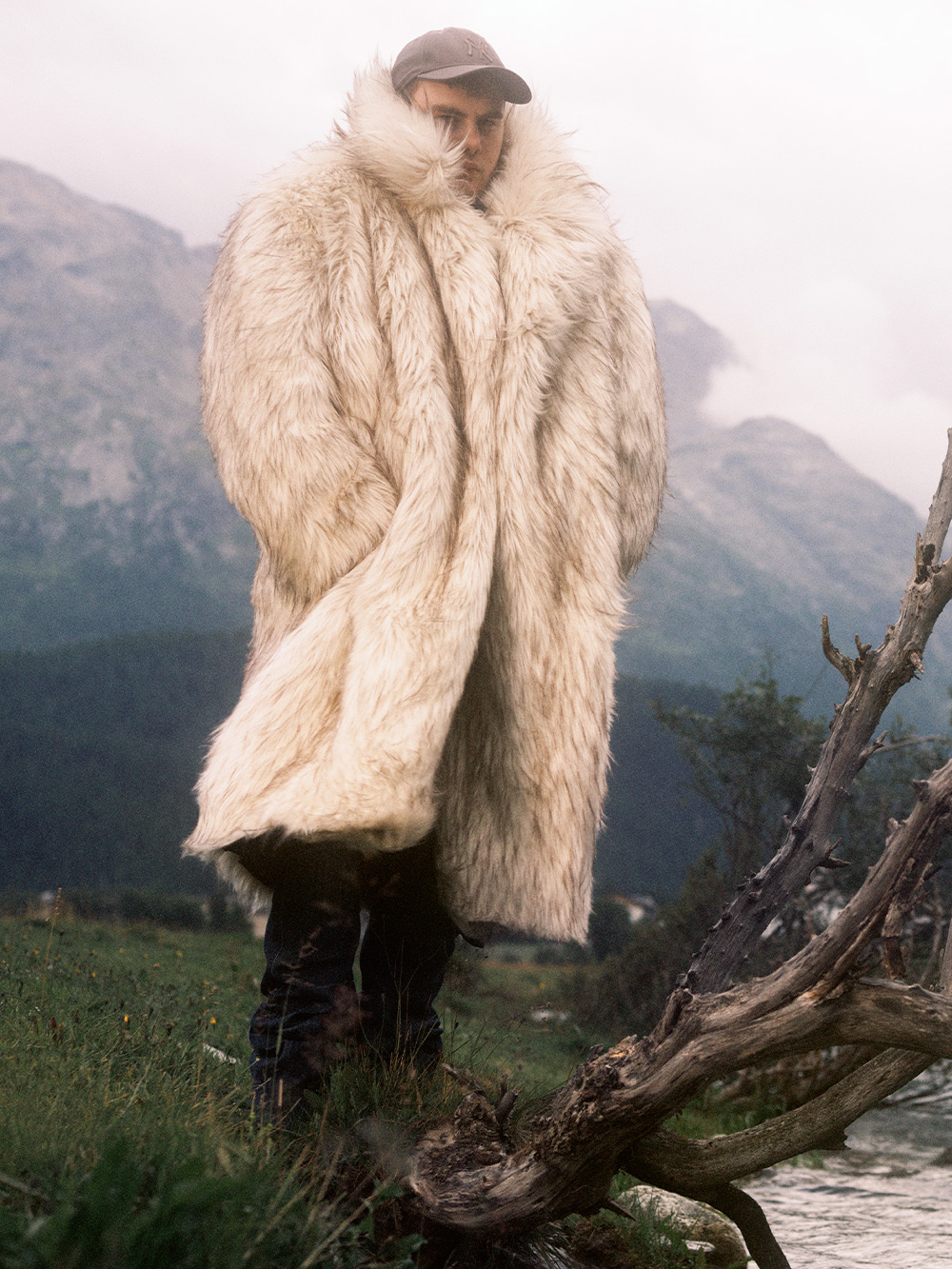
Sven Gex styled by Ursina Gysi and photographed by Marc Asekhame.
My Instagram Explore page used to be full of pictures of girls. That’s what the algorithms will show a man when they have no idea of what his interests are, or what kind of a person he is. I like to go to a museum first thing when I land in another country, as soon as I’ve checked into my hotel and had a coffee and a pastry. I’ll visit the art museum on the first morning before I have slept well, if at all, before my body even knows where I am; which is, I believe, a good way to be open to being moved. It is often when I’m worn out and confused that an artwork can pull me out of the ordinary world and into another space.
At the Kunsthaus Zürich I particularly enjoy: Frank Buchser’s DER KUSS (“The Kiss,” 1878), a painting of a shepherd boy in the summer hills crouching down over a sleeping country girl, presumably about to kiss her; the large crazed nineteenth-century symbolist (“Parallelist”) scenes by Ferdinand Hodler of groups of naked figures performing dances and rituals in the countryside; and through the Parallelist room, in one of the wood-paneled cabins at the back, a small Albert Welti of a man in a top hat, in a boat full of gold coins with faces painted on its side, rowed down the river at dusk by a goblin. Throughout the museum there are hints of a more magical natural world, a folkloric ecstasy over the hills. One night my girlfriend Olivia and I go to a rave at an artist-run space by the Limmat where they are selling MDMA punch in the courtyard, and there we meet a shepherd of sorts, or some kind of young wizard, this soft and gentle guy with a large staff who says he’s come up from the countryside for the party, and thought he’d talk to us because we had a good vibe when he saw us by the fire.
There’s a Niki de Saint Phalle angel high up in the rafters at the station. Leaving Zürich, we board a train down to the Bernese Oberland. We disembark at Spiez, by the shore of Lake Thun, and take a yellow bus up the steep winding roads to our chalet high on the verdant slopes among the farms. The next morning we wake early as planned. After a light breakfast of coffee, yogurt and toast, we take one tab each of “Orange Sunshine,” which our painter friend from New York has given to us. It’s a warm sunny day up in the mountains. I lie about on the loungers waiting for the LSD to take effect, watching the breathing pictures in the Hauser & Wirth magazine, and the light-filled Muslim family playing on the lawn, becoming confused, slowly unraveling. After a short while we’re ready to go.
From the hotel it’s a short walk up the road through the pastures where cows are mellowly grazing, their bells clanging melodiously through the valleys, to the wanderweg along the range from tree to tree and its sweeping panorama of cloudy dreamy turquoise Lakes Thun and Brienz, and the town of Interlaken down there between them. We wander this small patch of hillside losing track of time and space. Interlaken seems very near. The mountains on the other side of the valley look close, like I could leap across to them, like we’re on top of the world, and the world is ours, spread out before us, full of adventures waiting for us.
Taking acid in the mountains feels Nietzschean; I give myself a powerful electric shock holding onto one of the fences around the cow fields to check if it’s electric. At first it seems that it’s not, but then it shoves me back up into the air and down on the tingling grass. I feel connected to everything. It is as though we have returned to the time of the epic. I feel like I’m a god, or a shepherd in the hills in the time of the gods, or a woodland sprite. Like I’m in Buchser’s painting of the goatherd boy, like I’m wandering through Ovid’s Metamorphoses, which is just how I’d like to live. I’ve been told that Switzerland still has a rural traditional peasant culture that’s no longer present in other wealthy countries: like in the town of Zermatt perhaps, where the black and white goats are walked through the streets twice a day in the morning and afternoon by children in traditional dress and hiking gear, or maybe like the guy with the staff outside the gallery.
Olivia is picking a bouquet of wildflowers in the meadow. She’s looking very closely at the blooms and the buzzing life and talking about what’s going on, delivering streams of live synesthetic visual theory and pastoral poetry down in the poppies in rings of colored flare. She is speaking in her poetry to the bees and the flowers, and I’m looking out over the landscape thinking I might be a god. Everything feels so natural and right. The Alps are wonderful, Switzerland is wonderful. Walking about in the sunshine tripping out with the dairy cows in this Arcadian fantasyland is one of the happiest experiences of my life. But like a shepherd in mythical times, I grow restless.
I want to leave the pasture, and the village and the valley, and see what else this world has to offer. I want to go down to Spiez, and ride the train to Interlaken, right over there, and Lauterbrunnen, to see the waterfall that inspired Goethe’s “Song of the Spirits over the Waters,” high on acid, and have a transcendent psychedelic mystical-Bernese experience of nature and poetry combined together, which could be the most powerful aesthetic experience of my life! We go down to the village to wait for the yellow bus to arrive. We look through the windows of the empty schoolhouse.
As we sweep down the mountain on the bus I soon realise that I’ve made a terrible mistake. I’m overcome by vertigo and motion sickness and think I’m going to vomit. It feels like we’re riding on the back of a giant eagle down into the valley. At one stop a large group of small children get on, and we’re surrounded by noisy Swiss children, coming down the mountainside from paradise, returning to civilisation and its loudness and ugliness: to modernity. We have descended into the underworld, which it turns out is just the real world.
By the time we get to Spiez, Olivia does not want to be there, does not understand why we left, or why I’ve taken us here. The Oberland, just now so full of love, feels menacing and evil; and I realise, in front of the station, by the blaring cars and demonic Swiss valley-dwellers, that I’ve ruined this day we’ve been waiting for for weeks, this perfect day, because I always wish to experience more. For the first time in my life I’m having a very bad trip. I try to lead us down to the turquoise water, but we never do make it there.
I used to hear frightening stories about acid as a teenager so I never tried it. In England we were told that it would bring out the darkness within, and give you terrible flashbacks for the rest of your life. I remember hearing a story about a guy who had seen a little gnome while he was tripping, and for the rest of his life it followed him around, and wherever he went he’d often see him, this little gnome standing in the corner of the room watching, like in the painting by Welti. Back at the station, I’m able to pull myself together and hail a taxi that drives us, extremely fast, back to the tranquility of the hotel and the mountain. It feels like we’ve traveled to another realm and back.
Returning to the path between the trees, we follow it further up the mountains. At points there are so many butterflies and wildflowers humming deliriously about us that it feels ridiculous that nature could be so vibrant. Meadow birds pass by, bobbing up and down in the air before disappearing into the grass. We’re back in heaven, we’re picking tiny wild strawberries. We’re running down through the meadows at sunset to pick up our dinner box and our wine, the drink of the gods.
The next day we go see the waterfall in Lauterbrunnen and it’s fine. The water leaves the cliff and floats away, and does look like it’s becoming spirits. I don’t think this experience would have been much enhanced by tripping. We read the Goethe poem from our phones to one another before noticing it’s already there on a plaque right in front of us. Not a great poem. It speaks of how our lives are blown about by fate. It goes, “Wind is to wavelet tenderest lover:/ Wind from the deep tears foam-crested billows./ Soul of man mortal, how art thou like water!/ Fate of man mortal, how art thou like wind!”
Interlaken and Zermatt are very international towns, full of Indian and Chinese tourists. We dine at great Indian restaurants in both: particularly India Village, down by the river in Interlaken next to the campsite, which has one of the best Yelp ratings of any place in town. They don’t have mango chutney, but they serve a decent glass of wine, which is not the case in most Indian restaurants in England. Under the Jungfrau (the Virgin Mountain) next to the grand old Victoria-Jungfrau Hotel and its excellent cocktail bar, there’s the Interlaken Hooters where young women in orange booty shorts and white vests serve American hot wings and beer, keeping alight this enduring fantasy of virginity, revelry and lust, but there aren’t so many Americans around in the Alps these days, and not many English either. You really feel in towns like these that the global economy now belongs to the Indians and the Chinese.
We take the train to Jungfraujoch, the top of Europe, half-buried under the snow on the frostbitten saddle between the Jungfrau and the Mönch. It’s an extraordinary place, a high-altitude research station 3,463 meters up and a glossy multi-story tourist mall that seems to be targeted primarily at Indians. Up here there’s Europe’s highest-altitude Indian restaurant, Bollywood, with cardamom- scented views over the Aletsch Glacier. There’s Lindt Swiss Chocolate Heaven, and luxury restaurants and watch stores, ice tunnels and ice carvings to explore, and places where you can walk out into the freezing-cold sky, where black choughs flap around you and eat from your hands.
There’s an elderly Buddhist monk in red robes in a wheelchair with no shoes on, come to visit from far away. It’s all very otherworldly. It’s a cloudy day so we can’t see back down to the country below, we can’t see anything, and this gives a pleasantly surreal feeling of having died, as though we are all milling around above the clouds, part way to nirvana, subsisting on Lindor truffles in this strange internationalist duty-free bardo of the twenty-first century.
Over Jungfraujoch whipped-cream coffee in the café, by giant windows of thick white fog, we read verses of “Mont Blanc: Lines Written in the Vale of Chamouni” by Percy Bysshe Shelley to one another, in which he says, “The everlasting universe of things/ Flows through the mind, and rolls its rapid waves,/ Now dark—now glittering—now reflecting gloom—/ Now lending splendour, where from secret springs/ The source of human thought its tribute brings . . .”
It’s a better poem than Goethe’s we agree, this romantic metaphysical excavation of the Alpine landscape, and well suited in its speculative endeavor to the research-station setting. Shelley proposes that we’re joined with the mountains and everything else by a shared consciousness or cosmic energy, and has more to say, and more lyrically so, about the transcendent experience of everything, and how the mind’s search for language brings meaning to life; the search for images too, perhaps. I’m writing from New York. Now on Instagram I’m served endless reels of the Swiss Alps every day, endless portals back into the mountains. The waters are milky, the grass, very green. All the colors appear more saturated, glowing extra brightly from within. I’m served one from Spiez; it doesn’t look so bad. I wouldn’t mind going back down there someday, to remember that feeling of everything coming apart..